
The Best Neighborhoods for Anglo Families in Israel Real Estate in 2026 Modiin Anglo Community Guide: Neighborhoods, Vibe and Property for Buyers, Investors & Olim
- May 11
- 23 min read
Israel Properties by Stamelman & Partners|Anglo Communities Series

When you speak to Anglos who have made Aliyah in the last decade, Modiin comes up again and again as a serious contender – and for many, it’s the final choice.
Situated roughly halfway between Jerusalem and Tel Aviv, with fast access to the train, highways and Ben Gurion Airport, Modiin offers something unusual in Israel: a modern, master‑planned city that actually feels like it was designed for families.
In this guide I’m focusing on Modiin through a specifically-Anglo Lens.
Which neighborhoods Anglos tend to choose, what the day‑to‑day vibe feels like, and how areas like Buchman, Kaiser, Shimshoni, Tziporim and Moreshet compare when you are choosing where to live or invest.

Why Anglos Keep Choosing Modiin
Modiin has grown into one of the most popular destinations for English‑speaking Olim, with thousands of Nefesh B’Nefesh olim calling it home. It combines a few things that rarely come together in one place:
Central location between Israel’s two biggest job markets.
Modern infrastructure, roads, trains and parking that were planned, not “patched on”.
Strong schools and a youth‑oriented environment with parks, playgrounds and sports facilities built into the city plan.
A large, visible Anglo population, alongside a very healthy mix of native Israelis, French, and other immigrant groups.
Unlike some classic Anglo enclaves, Modiin is mixed religiously and culturally, but most neighborhoods still have a clear character, which matters a lot when you are picking a street for your family. The majority of the Anglo community is dati leumi or traditional, but you’ll find secular, Masorti and chareidi families as well, usually living side‑by‑side in the same buildings or blocks.

How Modiin is Structured
Understanding the basic city plan helps you decode the neighborhoods. Modiin’s residential areas wrap around a central municipal and business core, where you’ll find the central train station, Azrieli Modiin Mall and many public institutions. Around that core sit multiple residential “rings” and sub‑neighborhoods, each with its own local parks, schools and small commercial centers.
Most Anglo‑popular areas fall into a few clusters that come up repeatedly in Aliyah and property discussions:
Buchman (Shvatim and Moriah) – the southern, more established “suburban” hill.
Central/older Modiin – including Shikun Bet/Gimmel and nearby areas.
Kaiser (Avnei Chen), Shimshoni (Nechalim) and surrounding established neighborhoods.
New western/north‑western neighborhoods – Tziporim, Nofim and Moreshet.
Nefesh B’Nefesh specifically highlights Shvatim (North Buchman), Moriah (South Buchman), Avnei Chen (Kaiser), Nechalim (Shimshoni), Nofim, Tziporim and Moreshet as popular with Olim, which is usually a good starting list for anyone coming from abroad.
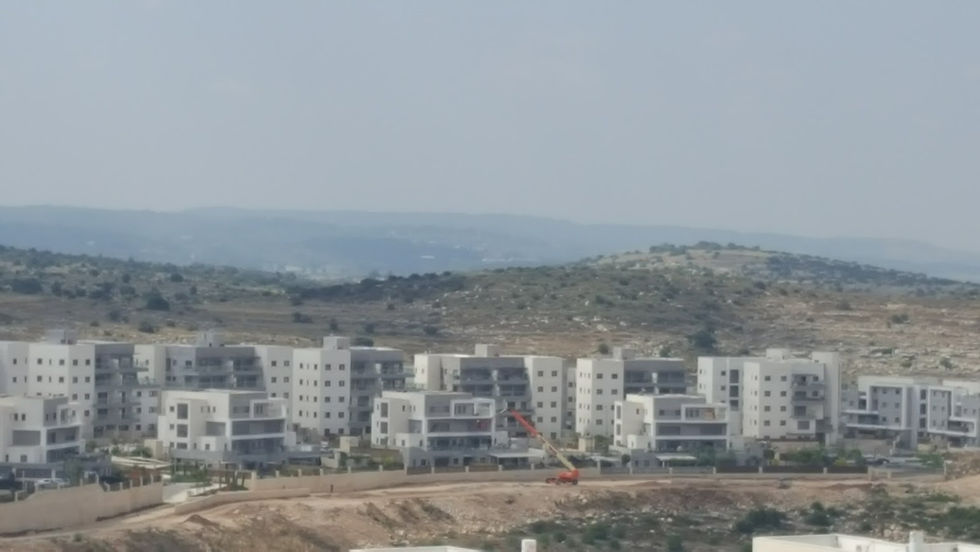
Buchman: Classic Anglo Hillside Living
Buchman, split into Shvatim and Moriah, is probably the best‑known “Anglo neighborhood” in Modiin. It sits on the southern side of the city and is characterized by low‑rise buildings, duplexes and larger homes, with strong community institutions and shuls.
If you are coming from a North American suburb, Buchman will feel familiar: quiet streets, family‑sized homes, a meaningful religious infrastructure, and a very high proportion of English being spoken in parks and on Shabbat afternoons. It is also one of the more expensive parts of Modiin in price per meter, reflecting both demand and the limited ability to add lots of new stock.
Who Buchman suits
Families looking for a strong modern‑Orthodox community and maximum Anglo density.
Buyers prioritizing space, community institutions and long‑term stability over being next to the train.
Investors who care more about low vacancy and resident stability than about absolute yield.
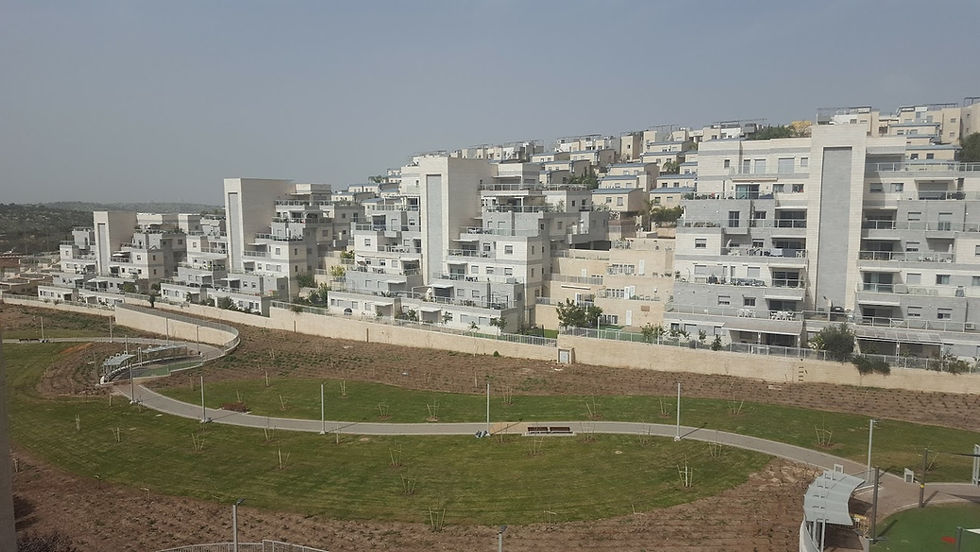
Central Modiin: Shikun Bet and Gimmel
Shikun Bet and Gimmel are what many people imagine when they think of “classic Modiin”: mid‑rise buildings, parks on every corner, and a very practical, family‑oriented street grid. These areas are extremely popular with Anglo families who like the mix of suburban feel with proximity to central shopping, schools and services.
Buildings in these areas are generally older than in the new western neighborhoods, but that also means mature greenery, established communities and less ongoing construction noise. For buyers, the appeal is a balanced price point: usually cheaper than Buchman’s large homes, but in a location that is very easy to live in day‑to‑day.
Who central Modiin suits:
Families who want to be “in the middle of everything” without feeling like they live in a dense city center.
Olim who are happy with a mixed religious and cultural environment, not a purely Anglo bubble.
Long‑term residents and second‑generation Anglos who value walkability and quick access to the mall, train and central bus routes.
Kaiser (Avnei Chen): The Central‑West Hub
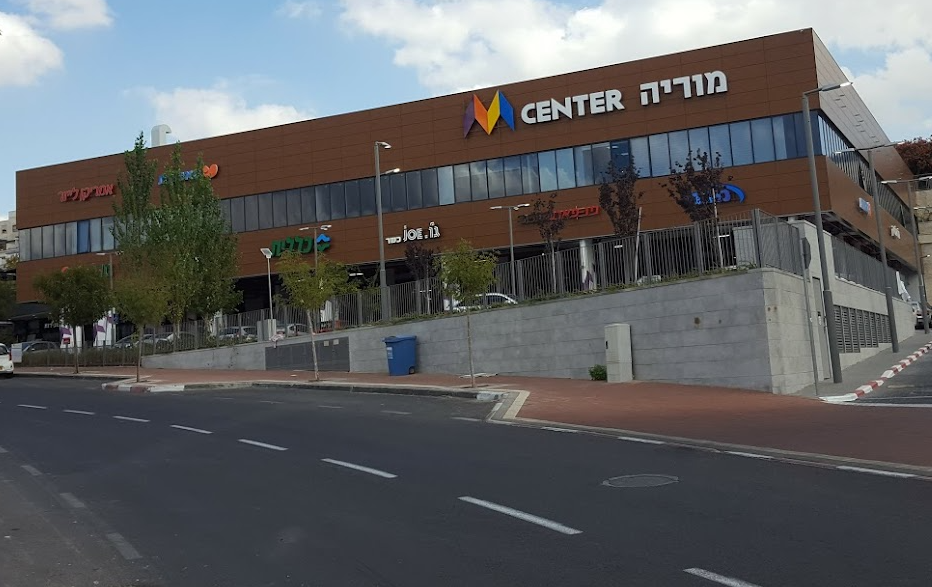
Kaiser, also known as Avnei Chen, sits on the western side of the city and has become both a popular residential neighborhood and a key services hub, thanks to the large Kaiser commercial center. For residents of nearby Moreshet, Nofim and Tziporim, Kaiser is effectively “where you go for everything” until the new neighborhoods’ own centers are fully built out.
The neighborhood itself offers a mix of buildings and housing types, and has a solid Anglo presence alongside a wide cross‑section of Israeli families. From a livability perspective, Kaiser is attractive if you want to be a short walk from supermarkets, cafes, local services and bus lines, without living right on the central mall.
Who Kaiser suits:
Families who want a strong mix of convenience and community, with easy access to shopping and shuls.
Olim who prefer a neighborhood that already “feels complete” in terms of infrastructure.
Buyers who want a central‑west location that ties into the growth of the newer western neighborhoods.

Shimshoni (Nechalim): Established, Northern and Under‑the‑Radar
Shimshoni, often referred to as Nechalim, is an established neighborhood on the northern side of Modiin. It includes sections like HaNevi’im and HaMeginim, with a mix of low‑rise and semi‑detached housing plus some taller buildings. The feel is rooted and local – this is not a glossy, brand‑new project, but a neighborhood with real history and continuity.
HaNevi’im in particular is often noted for being central and walkable, with strong long‑term ownership patterns, while HaMeginim is highlighted for good “modern value”, balancing more recent construction with relatively attractive pricing. For Anglos, Shimshoni tends to attract those who are comfortable integrating into a more Israeli‑feeling area, while still enjoying the benefits of an established community and good access to the rest of the city.
Who Shimshoni suits:
Buyers prioritizing walkability and centrality over living in the newest project.
Families who are comfortable in mixed, less “Anglo‑branded” streets but still want other Olim around.
Price‑sensitive investors looking for neighborhoods where demand is steady but marketing buzz is lower.
Tziporim: Young, Fast‑Moving and Highly Liquid
Tziporim (literally “birds”) is a newer, north‑western neighborhood with streets named after birds, sitting near Nofim and south of the 431. It’s very much a family neighborhood, with modern buildings, playgrounds and proximity to open spaces like Anabe Park.
From a property perspective, Tziporim is interesting because data and local agents consistently highlight it – along with central areas – as one of the fastest‑turnover neighborhoods in Modiin. In other words, when apartments come on the market here at a realistic price, they tend to move. That’s a big plus if you’re thinking about future resale or you want to keep your liquidity options open.
At the same time, Tziporim is still maturing. Some services are in place and others continue to develop, and it benefits from nearby commercial options in Nofim and Kaiser as well as its own local centers.

Who Tziporim suits:
Young families who want modern apartments, parks and a relatively fresh community.
Investors who care a lot about liquidity and tenant demand rather than “old‑guard prestige”.
Olim who are happy to be part of a still‑forming social fabric rather than a long‑established Anglo scene.
Moreshet: The Big New Western Bet
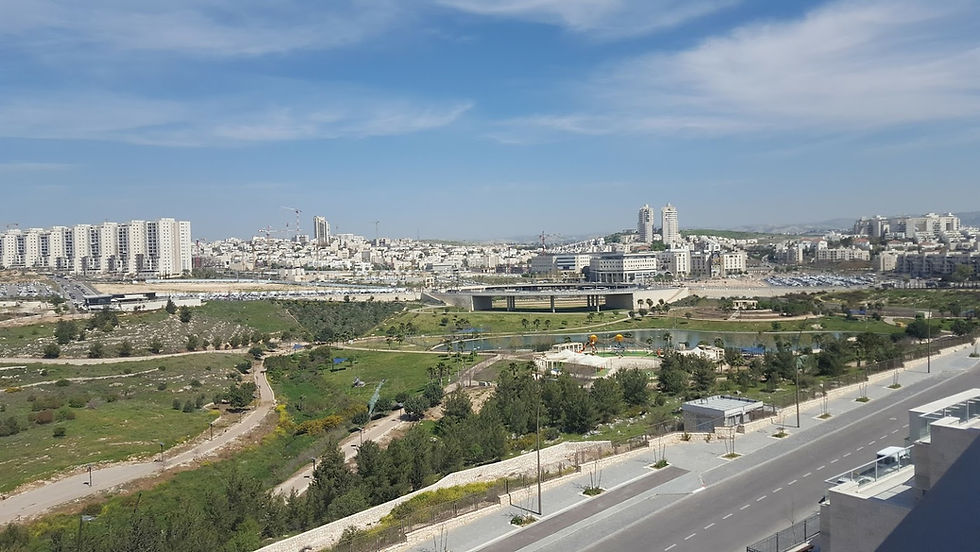
Moreshet is Modiin’s newest and also its largest neighborhood, with plans for roughly 4,000–4,300 residential units plus tens of thousands of square meters of commercial space, parks and public institutions. It is being built adjacent to an important Hasmonean archaeological site, and many projects overlook a central ecological park and future main boulevard with schools, shuls and shops.
Today, parts of Moreshet are already occupied and buzzing with young families, while other sections are still under construction. The community is deliberately mixed – Anglos and Israelis, religious and secular, younger and older – and the expectation is that it will become one of the most dynamic neighborhoods in the city once the full plan is realized.
Prices here have risen sharply in recent years, reflecting Modiin’s overall trajectory and particularly strong demand for new projects in Moreshet. Many apartments were originally allocated through government lottery programs, creating an interesting mix of owner profiles, and young Anglos have been actively eyeing opportunities in this area.

Who Moreshet suits:
Young families planning to grow into the neighborhood as it matures, not looking for instant “finished product”.
Buyers who want modern, energy‑efficient buildings and contemporary layouts.
Investors who believe in Modiin’s long‑term growth and are willing to weather construction years for future upside.
Quick Anglo‑Focused Neighborhood Snapshot

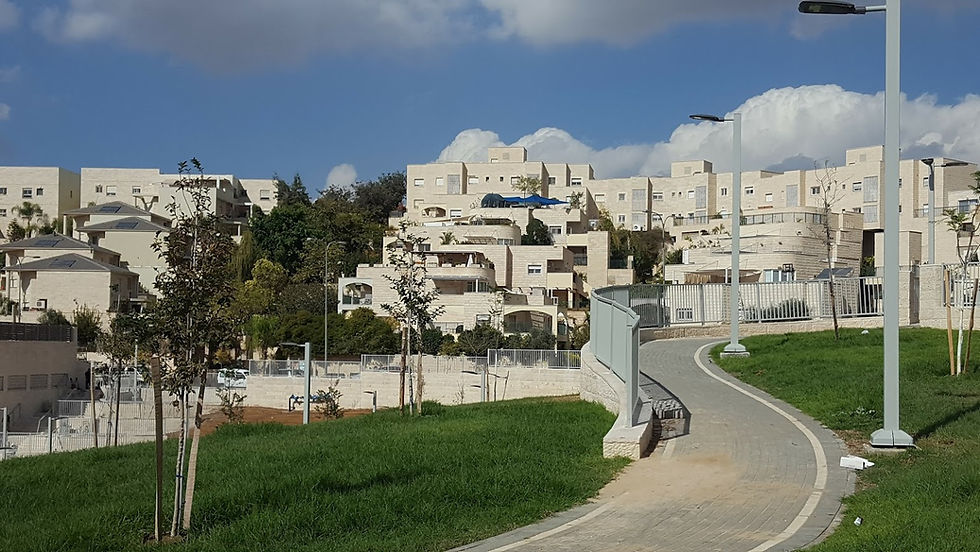
What Does “Entry‑Level, Comfort and High‑End” Look Like in Modiin?
When people ask, “What does it actually cost to buy in Modiin?” they’re usually really asking three questions: what’s the minimum to get in, what does a normal family home cost, and what does “Buchman villa” money look like. Below is how I break it down for Anglos, with very rough price and rental bands based on current market reports and active listings.
These are indicative only and can move quickly – always check current numbers before you make decisions.
Entry Level – “Just Get a Foot in the Door”
Entry level in Modiin usually means a compact 3–4‑room apartment (2–3 bedrooms), 70–90 sqm, in an older or more basic building. Think central Modiin on older streets, parts of Shimshoni, and some more modest buildings in Kaiser and other established areas – good access to parks and schools, but without the newest finishes or the most in‑demand views.
This is the typical starting point for young couples, small families and investors whose priority is simply owning something in Modiin and riding the long‑term curve.
Indicative purchase bands:
3 rooms (70–80 sqm): roughly 2.4M–2.8M NIS in older stock.
4 rooms (85–95 sqm) basic/older: roughly 2.7M–3.1M NIS depending on street, building condition and outdoor space.
Indicative rental bands:
3 rooms: roughly 5,500–6,300 NIS/month in central/older buildings.
4 rooms basic: roughly 6,000–7,000 NIS/month depending on exact location and condition.
In plain English: entry level in Modiin usually means a 3–4‑room in an older building in central Modiin or Shimshoni – budget on something in the mid‑2 millions to low‑3 millions to get your first foothold in the city, with rentals in the 5,500–7,000 NIS range for this segment.

Comfort Level – “Where Most Anglo Families Land”
Comfort level is where most Anglo families feel at home: a solid 4–5‑room family apartment (3–4 bedrooms) in a good building and location, with parking, elevator, decent outdoor space and easy access to schools, ganim and shuls.
Typical comfort‑level neighborhoods include strong streets in Shikun Bet/Gimmel, Kaiser, Tziporim, Nofim and much of the mainstream stock in Moreshet as it fills in. These areas give you the classic Modiin lifestyle without drifting into “luxury for the sake of luxury”.
Indicative purchase bands:
4 rooms (95–105 sqm) in good buildings: roughly 3.0M–3.6M NIS, with central/better streets pushing the top of that band.
5 rooms (110–125 sqm) in modern or well‑kept buildings: roughly 3.5M–4.3M NIS, with newer projects in Tziporim/Moreshet and well‑located Kaiser/Bet/Gimmel commanding the upper tier.
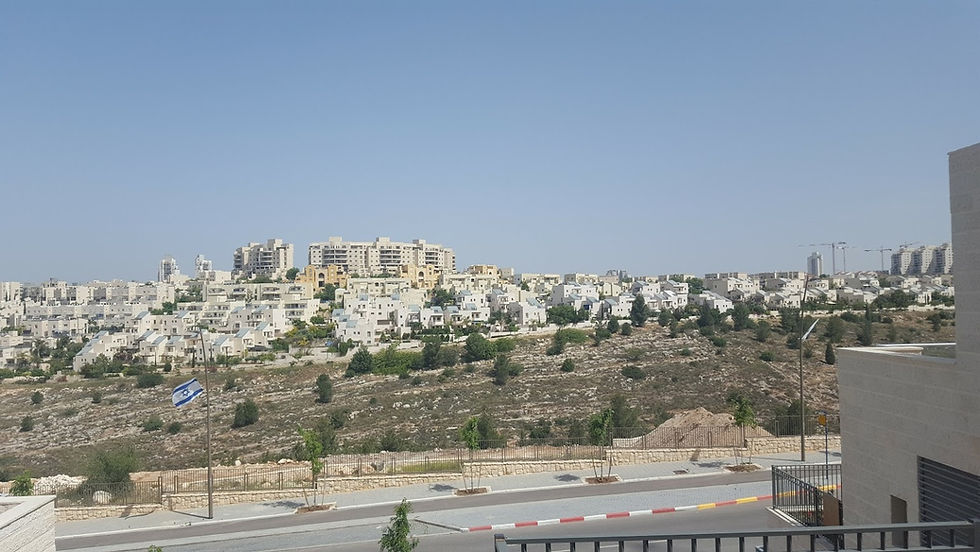
Indicative rental bands:
4 rooms: roughly 7,000–8,500 NIS/month depending on neighborhood and spec.
5 rooms: roughly 8,500–10,000 NIS/month, with newer or especially well‑located units sometimes higher.
In other words: comfort level for most Anglos in Modiin is a 4–5‑room family apartment in Bet/Gimmel, Kaiser, Tziporim or Moreshet. Think roughly 3–4.3M NIS to buy into this band and 7,000–10,000 NIS/month on the rental side for a solid family home.
High End – “Lifestyle, Space and Prestige”
High‑end Modiin means large homes and statement properties: big penthouses with wrap‑around terraces, sprawling duplexes and villas in Buchman and similarly prestigious pockets in Reut/Maccabim. Recent coverage of Buchman highlights new villa projects starting around 7.7M NIS, with many resale villas and large homes in the 7.5M–10M+ NIS range and even higher for truly exceptional properties.
You’re talking about 5–7 bedrooms, gardens, basements and views over the hills – homes designed for lifestyle and entertaining rather than squeezing out maximum yield per shekel. Large penthouses and top duplexes in prime streets also sit firmly in the multi‑million‑shekel “luxury” bracket, especially where there are expansive terraces and open views.
Indicative purchase bands:
Large 5–6‑room penthouses/duplexes (140–180 sqm plus terraces) in prime locations: roughly 4.8M–7.0M NIS, depending on building, views and outdoor space.
Villas/large cottages in Buchman and similar: typically 7.5M–10M+ NIS, with standout properties priced higher.
Indicative rental bands:
High‑end penthouses/duplexes: roughly 11,000–15,000 NIS/month (and up) for top‑tier product.
Large villas: often 15,000–20,000+ NIS/month, very case‑by‑case, as this is a thinner, more bespoke market.
In short: high end in Modiin usually means a big duplex, penthouse or villa – most famously in Buchman – with price tags starting in the high‑4s/5s for large apartments and running to 7.5–10M NIS and above for serious houses. On the rental side, you’re generally in the 11,000–20,000+ NIS/month range for this tier.
Purchase vs Rental Bands – At a Glance

Community, Religious Mix and Daily Life
One of the things people notice when they visit Modiin is how naturally mixed the city feels. Most neighborhoods are not defined by a single religious label, but by a dominant “flavor” with plenty of variation: Buchman leans more religious and heavily Anglo, while areas like central Modiin and Shimshoni have a stronger Israeli backbone and broader mix.
For families with kids, youth movements play a central role. You’ll find Bnei Akiva, Scouts and other frameworks active across neighborhoods, generally with multiple branches and a lot of participation from Anglo kids who integrate quickly because the city as a whole is used to absorbing newcomers. Shuls across the city tend to be welcoming to English speakers, with many offering some level of English‑friendly programming or shiurim.
From a practical perspective, Modiin’s municipality and absorption department are regularly praised for the quality of services to Olim. It sounds dry, but in real life it can make the difference between feeling stuck in bureaucracy and actually getting things done in your first year.

Investment and Future Growth Considerations
If you’re thinking like an investor as well as a future resident, a few Modiin patterns stand out.
New western neighborhoods (Tziporim, Nofim, Moreshet) have become key growth engines, with modern projects and strong demand from young families.
Liquidity: data‑driven guides highlight Tziporim and central Modiin as areas with particularly fast turnover, which is crucial if you want the option to exit without a long wait.
Stability vs. upside: Buchman, HaPrachim and HaNevi’im are seen as high‑stability, slower‑turnover areas – excellent for families wanting long‑term roots, slightly less compelling if you’re chasing maximum yield or rapid appreciation.
Moreshet’s scale (4,000+ units, central park, commercial axis) means it will likely play an outsized role in shaping Modiin’s future property map, especially if you believe central Israel will continue to densify.
Prices in Modiin have risen strongly over the past decade, and reports focused on Moreshet in particular mention significant increases in a short span, reflecting how quickly demand has absorbed new supply. For medium‑ to long‑term investors who see Israel’s central corridor as the safest bet, a well‑chosen property in Modiin – especially in a neighborhood with clear Anglo demand – can be a strategic anchor.

How to Choose the Right Neighborhood for Your Family
When I work with Anglo families looking at Modiin, I usually suggest starting with three simple questions.
Community profile – Are you looking for a strong modern‑Orthodox Anglo community (think Buchman), or are you happy being one of several Olim families in a more mixed environment (central Modiin, Shimshoni, Kaiser)?
Lifestyle and commute – Will one or both of you be commuting to Jerusalem, Tel Aviv or elsewhere, and how important is quick access to the train or main roads compared with quiet, hilltop living?
Stage of life – Are you coming with little kids, teens or as empty nesters? Younger families often appreciate the energy and modern layouts in Tziporim and Moreshet, while families with older kids sometimes prioritize Buchman’s established institutions or central Modiin’s walkability.
Once you’ve answered those three, the map of “which Modiin” usually becomes much clearer – and from there, it’s about drilling down to the right street, building and layout for how your family really lives.

Choosing Between the Anglo Neighborhoods in Modiin
When you zoom out, each Anglo‑relevant neighborhood in Modiin offers a different blend of community, convenience and cost:
Buchman – flagship Anglo, religious‑leaning, large homes, premium pricing, “finished product” community.
Kaiser (Avnei Chen) – central‑west, strong services, balanced Anglo/Israeli mix, 4–5 room comfort segment, directly tied into the growth of the western side.
Moreshet – new, large and high‑rise; young families, future‑oriented planning and strong recent price momentum.
Tziporim – young, fresh, modern; quick turnover and good liquidity, with strong appeal for families and investors.
Bet/Gimmel – central, park‑rich, very Anglo‑friendly, great for those who want a classic Modiin family lifestyle without outer‑ring newness.
· Shimshoni (Nechalim) – established, more Israeli feel, interesting for value and for buyers who want Modiin but don’t need a perfectly packaged Anglo bubble

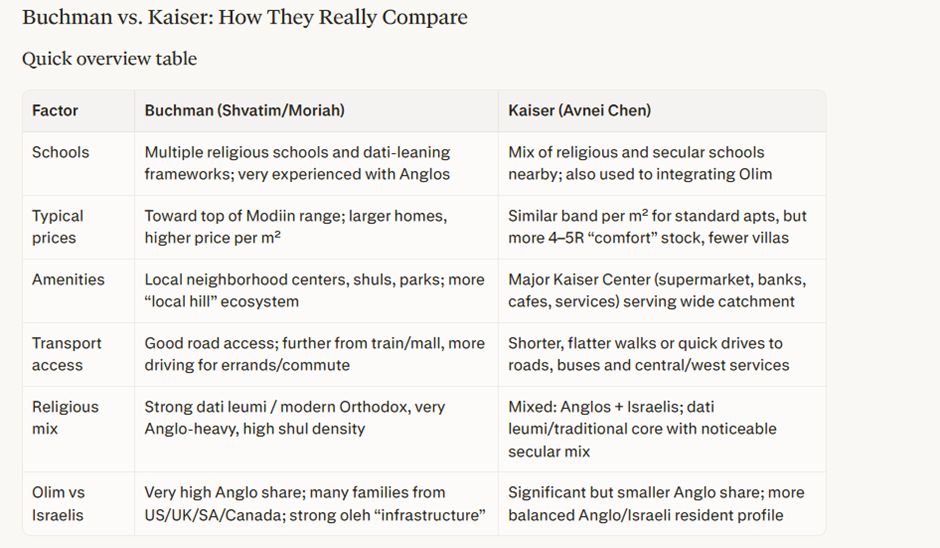
Vibe and community
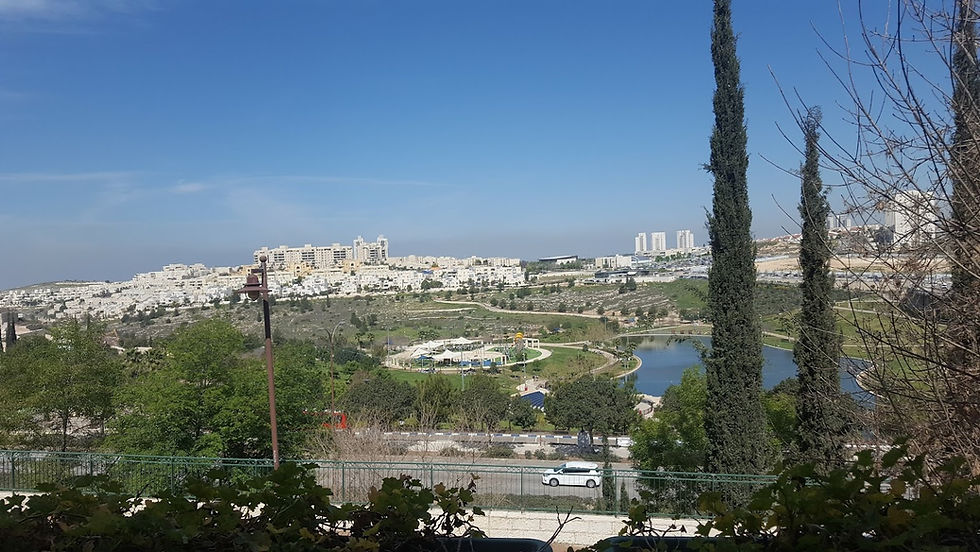
Buchman feels like Modiin’s flagship Anglo hillside neighbourhood: low‑rise homes and duplexes, strong Dati Leumi infrastructure and a very visible English‑speaking presence. It’s quieter, more suburban and very shul‑centric, with a rhythm built around Shabbat, youth movements and community life in parks and batei knesset.
Kaiser, by contrast, feels more like a central‑west, mixed family hub: mid‑rise buildings, parks and a strong community vibe, but with a more urban‑practical edge thanks to the Kaiser Center and its position closer to the city’s core. It attracts Anglos and Israelis who want to be in the middle of things – shops, buses, services – without living right on the mall or train station.
Schools and kids’ ecosystem
Buchman is known for its strong religious school and youth framework, with local Dati Leumi schools and Bnei Akiva/Tzofim branches that are very used to absorbing English‑speaking kids. For a modern‑Orthodox Anglo family, the whole pipeline – gan, elementary, youth movements and shuls – is already built around that lifestyle, and a lot of your children’s social world sits inside Buchman itself.
Kaiser shares Modiin’s general advantage of high‑performing schools city‑wide, but the educational environment around it is more mixed – religious, traditional and secular frameworks all within reach, and many families choosing schools from across the city rather than only in‑neighborhood institutions. Anglo kids integrate into a more varied class profile here, with both Olim and sabra families and multiple religious levels represented.
Prices and housing stock
Buchman leans decisively into larger, higher‑end homes – cottages, semi‑attached houses and big apartments – and sits toward the top of Modiin’s price spectrum per meter. New villa projects and record sales have cemented its status as a premium neighborhood, especially on its best streets, with many transactions firmly in the multi‑million‑shekel bracket.
Kaiser offers a broader spread of 4–5‑room family apartments and some townhouses, with strong demand but less of the “villa premium” that characterises Buchman. Per‑meter prices on good buildings are solid, yet most buyers here are in the “comfort band”: modern or well‑kept apartments rather than landmark houses, making it a go‑to for Anglos who want Modiin lifestyle without Buchman’s top‑tier ticket.
Amenities and daily convenience
Buchman’s amenities are highly neighborhood‑centric: small commercial clusters like Moriah/Terraza, local clinics, sports and many parks and shuls woven into the hillside streets. Day‑to‑day life feels self‑contained – you live, daven, play and socialise mostly within Buchman, driving out to the mall or train when needed.
Kaiser’s big advantage is the Kaiser Center, one of Modiin’s largest neighbourhood commercial hubs, with a supermarket, cafes, banks, pharmacies and a wide range of services under one roof. It also sits closer to the Azrieli mall and main city arteries, so grabbing groceries, meeting a friend for coffee or hopping on a bus is often a short, flat walk rather than a drive down the hill.
Transport and access
Buchman has good road access to the main highways but is further from the central train station and bus hub, so most residents use a car or bus for trains, intercity buses and big‑ticket shopping. If you work in Tel Aviv or Jerusalem, your commute is typically “Buchman to train/bus by car or local bus, then intercity”.
Kaiser is more central‑west and connected: it’s closer in to the city grid, with easy access to bus routes, main roads and the mall, making commutes and teen independence around the city simpler. For families who care about quick, practical access to public transport and services, Kaiser’s location can be a meaningful quality‑of‑life upgrade.
Religious mix and Anglo–Israeli balance
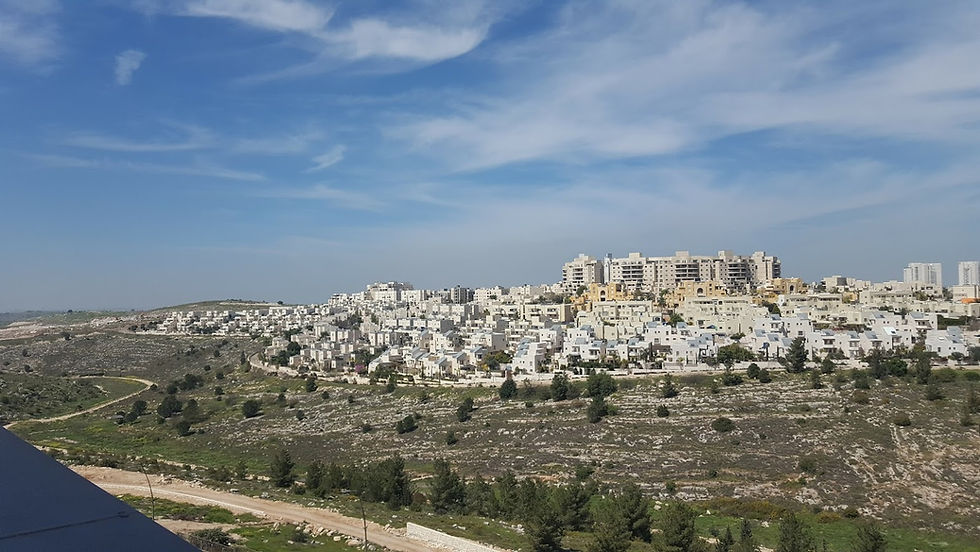
Buchman is one of Israel’s best‑known Anglo Dati Leumi concentrations, with a very high proportion of English‑speaking families from the US, UK, South Africa, Canada and beyond. The default is shomer Shabbat, shul‑ and community‑focused life; there are traditional and some more secular residents, but the dominant flavour is clearly modern‑Orthodox Anglo.
Kaiser is mixed by design: Anglos and Israelis, religious, traditional and secular, often share the same buildings, with several types of shuls and communities rather than one clear hashkafa. Anglos here are a strong presence but not the overwhelming majority, so it feels more like “real Modiin” – integrated and diverse – while still being very workable for English speakers.
Buchman “If you want a classic Anglo hillside experience – shuls on every corner, strong modern‑Orthodox schools and youth movements, large homes and a heavily English‑speaking street scene – and you’re willing to pay a premium for that model, Buchman is probably where you’ll feel most at home.”
Kaiser “If you prefer a mixed, central‑west neighborhood with a big commercial center, modern 4–5‑room apartments and a balanced Anglo/Israeli crowd, with buses, shops and services on your doorstep, Kaiser often hits the sweet spot for Anglo families who want community plus convenience.

Vibe and community
Moreshet feels like the flagship new western neighborhood: big, dense, high‑rise and designed as a complete mini‑city with its own ecological park and commercial strip. The average age is very young – around mid‑20s – and you see strollers, playgrounds and new buildings everywhere, giving it a buzzy “we’re all building this together” energy.
Tziporim, by contrast, feels more like a modern neighborhood tucked near nature: newer apartment projects, playgrounds and family‑friendly streets sitting close to Anabe Park and open green areas. It attracts young families and investors who like modern stock and strong demand but prefer a slightly quieter, less “urban‑tower” feel than Moreshet.

Schools and kids’ ecosystem
Moreshet was planned with schools and ganim built in: recent census data lists 3 schools and around 20 preschools inside the neighborhood, plus six synagogues and plenty of youth‑oriented parks and play areas. For a young family, that means a lot of your daily routine (gan, school, park, shul) can happen within a short walk of your building.
Tziporim does not have the same scale of internal institutions yet, but it plugs straight into the existing western Modiin ecosystem, using schools and ganim in nearby Nofim, Kaiser and other adjacent areas. For most Anglo families, the practical difference is whether they want the “everything is inside the project” feel of Moreshet or the slightly more spread‑out but still very workable network around Tziporim.
Prices and housing stock
Moreshet is dominated by new high‑rise buildings with elevators and underground parking, and recent data pegs average prices around 29,000 NIS per meter, reflecting strong demand for new, central‑west stock. Many units were sold via government lottery programs, and price reports talk about sharp increases over a short time as projects delivered and the neighborhood filled.
Tziporim is also a newer western neighborhood, but the stock tends more to “regular” modern family projects than large, dense high‑rise clusters. Agents consistently highlight Tziporim as one of Modiin’s fastest‑turnover areas: correctly priced apartments move quickly, which is very attractive for both resale‑minded buyers and investors focused on liquidity.
Amenities and daily convenience
Moreshet’s design includes its own “city center” strip: a main spine with restaurants, cafes, shops, medical offices, schools and public buildings, plus 11 parks, a large ecological park and a ninja park. Some of this is still being built out, but the plan is clearly for a self‑contained, walkable neighborhood where most day‑to‑day needs can be handled without leaving the area.
Tziporim has its own smaller local centers but relies heavily on nearby Nofim and Kaiser for heavy lifting: Kaiser Center for supermarkets, banks and services, Nofim for additional shops and cafes. If you like the idea of walking down to a big, busy strip in your own neighborhood, Moreshet wins; if you prefer a quieter home area with a short hop to Kaiser/Nofim when you need things, Tziporim is often the better emotional fit.
Transport and access
Both sit on Modiin’s western side, with good access to main roads and the wider city. Moreshet is explicitly described as within walking distance of Kaiser, letting residents tap into Kaiser’s bus lines and services while staying in a new neighborhood. It has at least eight internal bus stops and a street grid planned with accessibility in mind, although the hilly topography and high‑rise density give it a more “urban west” feel.
Tziporim sits closer to Route 431 and open spaces, so car access out of Modiin is very straightforward, and internal city driving to Kaiser or the mall is short. Practically, many families in both neighborhoods still use cars for the train and major errands; the difference is more about local walkability versus direct road access to nature and highways.
Religious mix and Anglo–Israeli balance
Moreshet is a deliberately mixed neighborhood from day one. Local profiles emphasize a large cross‑section of demographics – Anglos and Israelis, older and younger, religious and secular – with no single hashkafa dominating, and only a handful of shuls so far spread across different styles. Anglo presence is growing, but census data still shows olim as a minority of residents, so it feels more like “new Israel” than an Anglo enclave.
Tziporim is also mixed, but with a slightly more “classic Modiin” feel: a visible Anglo presence, strong demand from young families and a balance of religious/traditional and secular residents in the same buildings. For some Anglos, Tziporim feels like the natural continuation of Kaiser/Nofim energy; for others, Moreshet’s scale and urbanity are the draw, especially if they want cutting‑edge new projects and long‑term upside in a single, large neighborhood.
Moreshet: “If you want big‑neighborhood energy – high‑rises, a planned urban strip, and the feeling that you’re in Modiin’s ‘next big thing’ – and you’re happy with a very mixed, young crowd, Moreshet is probably your western home base.”
Tziporim: “If you prefer a slightly quieter, closer‑to‑nature western neighborhood with modern projects, fast turnover and easy access to Kaiser and Nofim, Tziporim often hits the sweet spot for Anglo families and investors.”
Where Nofim Fits in the Modiin Story
Nofim (“views”) is a modern, family‑friendly neighborhood on the western entrance to Modiin, north of Road 431 and just south of Anabe Park. It has around 1,845 residential units, lots of children’s parks, big green areas and panoramic views over other Modiin neighborhoods and valleys, which is why local agents call it “the Diamond of Modiin”.
Physically, Nofim sits between Moreshet and Tziporim and is linked to them by bridges, making the three functions almost like one western cluster with slightly different Flavors. It’s a short drive to Yishpro/Einav commercial center and relatively close to the Pa’atei Modiin train station and Modiin town center, which keeps it practical for commuting as well as lifestyle.
Nofim = views + parks + quiet, Tziporim = modern + liquid, Moreshet = big‑scale, urban‑new west.

Vibe and feel
Nofim is marketed locally as a beautiful, calm neighborhood with big views, plenty of children’s parks and a quiet feel, ideal for families who want a serene base rather than a buzzy central hub. Its hilltop position and open outlook over the city and valleys are a core part of its identity and selling story.
Tziporim is also modern and family‑oriented, but the brand is less about views and more about being a young, fast‑moving western neighborhood with strong demand and modern stock. Both draw second‑generation Anglos and young families, but Nofim leans “quiet with views”, Tziporim leans “modern with momentum”.
Location, parks and nature
Nofim sits north of Road 431 and just south of Anabe Park, with bridges linking it directly to Tziporim and Moreshet, so you get excellent walkable access to green space plus quick car access to the city. The neighborhood’s size (around 954 dunams and 1,845 units) gives it scale, but it still feels more like a neighborhood than a dense urban node.
Tziporim also borders Anabe Park and benefits from the same open valley and walking routes, but it doesn’t have quite the same hilltop “lookout” feel and panoramic branding that Nofim has. For nature‑minded Anglos, both work; if views and a slightly quieter slope matter a lot, Nofim has the edge.
Amenities and daily convenience
Nofim doesn’t have a huge standalone commercial strip, but it is only a short drive from Yishpro/Einav business center and has quick connections to Kaiser and central Modiin for supermarkets, banks and services. The everyday feel is “quiet residential with parks”, using the broader western ecosystem for shopping rather than relying on a single internal center.
Tziporim has its own smaller centers and leans heavily on Kaiser and Nofim for serious shopping and services, making day‑to‑day errands straightforward if you’re happy to do short car trips. Because of its strong demand and fast turnover, you’ll often see more visible real estate activity there – sales, new listings, renovations – than in Nofim at any given time.
Nofim: “If your dream Modiin move is coffee on a balcony with a real view, kids running between big parks and a slightly quieter, more ‘finished’ feel on the western hill, Nofim is the diamond you should look at first.”
Tziporim: “If you want modern apartments, family energy and a neighborhood that’s known for fast resale and strong demand – even if it feels a bit busier and more transitional – Tziporim should be high on your shortlist.”

Vibe and scale
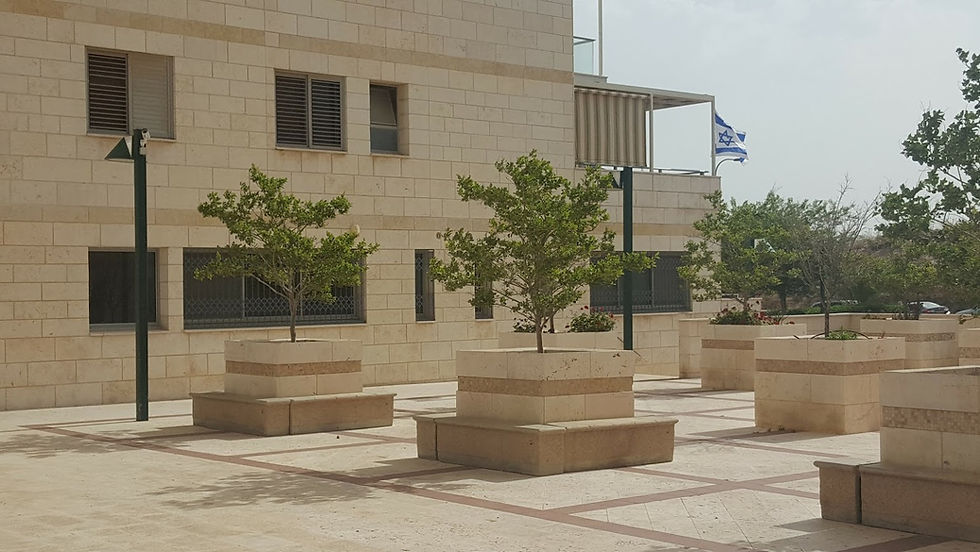
Nofim is described locally as a beautiful, quiet neighborhood with many children’s parks, panoramic views and a calm feel, sitting on a green hill at the western entrance to Modiin. It has around 1,850 apartments and just under 6,000 residents, so it feels substantial but not overwhelming.
Moreshet is much more of a “big new west” statement: around 8,000 residents already, average age under 24 and half the population under 19, with thousands more units planned as projects complete. On the street, that translates into a denser, buzzier environment of strollers, playgrounds and cranes – a neighborhood that is still actively being built.
Housing and layout
Nofim’s stock is largely mid‑rise apartment buildings and family projects, laid out across a hill with many apartments overlooking the city and valleys. For buyers, the signature is “modern Modiin family apartments with a real view”, rather than high‑rise towers.
Moreshet, by contrast, is dominated by high‑rise buildings with underground parking, elevators and contemporary layouts, wrapped around a central ecological park and a planned commercial strip. It offers the largest concentration of brand‑new 4–5‑room apartments in west Modiin, plus larger units and penthouses for buyers looking at long‑term value in a big new neighborhood.
Amenities and daily life
Nofim is a few minutes’ drive from major shopping and entertainment at Yishpro/Einav and has quick access by car or bus to central Modiin, while relying on its own internal parks and small commercial areas day‑to‑day. Daily life feels more like “quiet residential hill that connects to the rest of the city when you need it”.
Moreshet was designed to be self‑contained: a central ecological park, 11 different parks and playgrounds, a ninja park, and a planned urban strip with shops, cafes, medical offices and public institutions running through the neighborhood. As more units fill in and the commercial axis matures, you can expect most daily needs to be walkable from inside Moreshet.
Who each one fits
Nofim: best for families (including Anglos) who want a young but slightly calmer environment, strong views, lots of parks and are happy to drive a few minutes for big shopping or the train.
Moreshet: best for young families and investors who want maximum scale, newness and future upside, don’t mind construction, and like the idea of living inside Modiin’s biggest new western project.
A Personal Modiin Story
Almost ten years ago, when we made Aliyah, I spent my first year in Israel at RE/MAX Modiin as the assistant to the CEO, with one clear goal: learn how real estate really works in Israel, complete my Israel Real Estate licence and get hands‑on experience. Late one Thursday afternoon, just before the weekend, I was alone in the office getting ready to leave when the phone rang.
On the line was an American woman. Her first question was, “Are you Israeli?” I told her I wasn’t – that I was originally from South Africa – and asked how I could help. She explained that they were thinking of selling their home in Modiin and wanted someone to come see it. I went over, we shared our stories, and very quickly realised that we were a good fit: we could help them sell their current home and buy their next one.
At the time there was a new marketing method just starting to be used in Modiin.
I called the senior agent I was partnering with at RE/MAX and he was excited to bring this approach to their property. The sellers, however, were very clear: they wanted me to handle the process with them personally, drawing on my years of real estate experience, with my partner guiding me on the nuances of the Israeli market and deal‑making. The brief was simple and demanding – sell as quickly as possible, for as much as possible, and buy their next home for as little as possible.
Baruch Hashem, within a few weeks we had two serious offers on their Buchman home. In a beautiful twist, the first buyer graciously agreed to step aside so that the second buyer – who had been waiting a long time to live near family – could purchase the house. The price we achieved was higher than anyone expected and above what had been quoted in the market at the time. It set a record for that year in Modiin on Yehuda Street in Buchman.
The story didn’t end there. We then helped the sellers buy their next home, again in Buchman, this time on Sara Imenu. We represented them as sellers and as buyers, making sure the entire move was as smooth and strategic as possible. It all came together around Purim – and it was, to put it mildly, a very joyous Purim.
Those transactions gave me the push I needed to launch Israel Properties and build the platform for Anglo buyers , Investors and Olim in Israel.https://www.israel-properties.com/our-story
With Hashem’s help and blessings, that Modiin success became the foundation for what we do today -helping English‑speaking families find their Home their Place where they Belong in Israel, one neighbourhood – and one story – at a time.

How Israel Properties by Stamelman & Partners Helps You Choose “Your Modiin”
At Israel Properties by Stamelman & Partners, we work with Anglo families, investors Olim and retirees across all of these Modiin neighbourhoods.
Our role is to:
Clarify your profile – Aliyah or second home, family or retirees, Dati Leumi or mixed, budget, need for proximity to shuls, schools and grandchildren.
Match profile to area –based on price, lifestyle and long‑term plan.
Analyze options and deals – price per m², building quality, view, rental potential and liquidity, so you understand not just the apartment but the market context around it.
Execute safely – from initial exploration through negotiation, due diligence, legal and financing, and, where needed, remote purchase from abroad.
For more information https://www.israel-properties.com/buy-with-us
Disclaimer
This article is intended for general informational purposes only. It does not constitute financial, legal, or investment advice, and should not be relied upon as a substitute for personalised professional guidance.
Property prices, rental yields, and market conditions In Modiin and across Israel are subject to change and may vary significantly depending on property type, location, specification, and market timing.
All figures, ranges, and insights presented reflect indicative market conditions at the time of writing and are provided as a general guide only.
Before making any property decision, we recommend obtaining tailored advice and conducting full legal, financial, and market due diligence.
At Israel Properties by Stamelman & Partners, we provide structured, end-to-end guidance tailored to each client’s objectives, ensuring informed and confident decision-making


Comments